
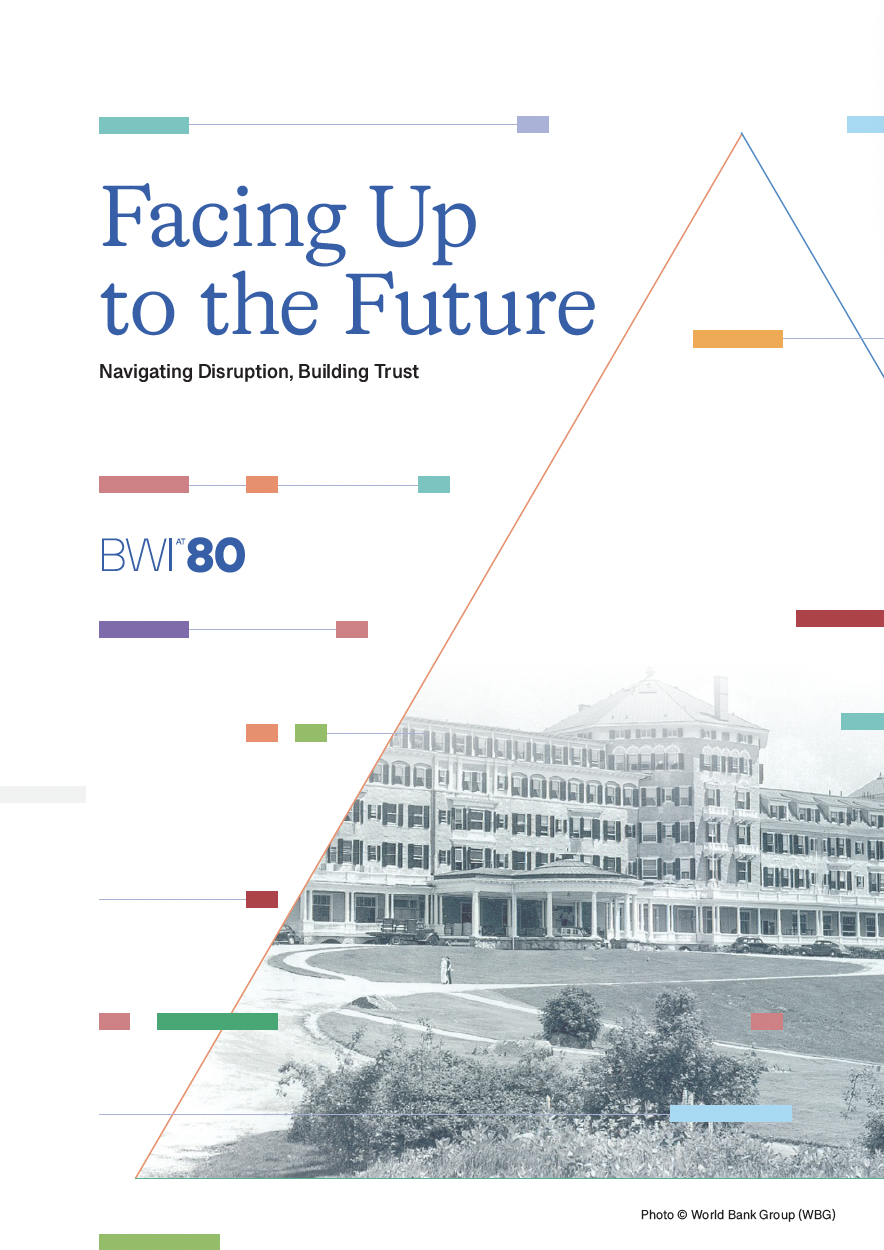
Facing Up to the Future: Navigating Disruption, Building Trust
Over the past eighty years, the Bretton Woods Institutions (BWIs) have contended with dramatic changes in the world, including shifts in the economic performance and standing of different nations; decolonisation and the fall of political systems; a demographic explosion; and a world economy that has grown twelve-fold.
The two institutions now find themselves on the frontline of a central contradiction of the contemporary world: economic systems are more globally integrated than ever – a legacy in part of that original Bretton Woods vision – but this integration has not prevented conflict. On the contrary, the world is experiencing more wars and related loss of life than at any point in recent decades. The national political institutions that once safeguarded this eighty-year journey towards an open world order now appear overwhelmed by the backlash, with people across the world increasingly viewing the multilateral system as a threat to their livelihoods and way of life. The implications for the free-market, open-border paradigms of development that the BWIs embraced are becoming stark.
Despite the challenges, the BWIs remain uniquely positioned to lead a new approach. They still offer scale, credibility, and technical expertise - but their continued relevance is not assured. It must be earned - not only through delivery, but by aligning with the evolving expectations of countries that are increasingly looking beyond traditional donors. The BWIs have competition. In a world of competing frameworks and rising power centres, legitimacy, we heard frequently, will depend on responsiveness, performance, and even-handedness across political lines.
Following a year of global consultations with ministers, civil society leaders, financiers, and practitioners, the message was clear: the BWIs must listen more, navigate today’s geopolitical complexities with care, and resist taking sides. Above all, they must put individual countries first - not the political priorities of any influential shareholders.
The three mutually reinforcing priorities emphasised in this report – country ownership, scaled up finance, and modernised governance – are not standalone objectives. They are interdependent, and each is indispensable to effective reform. In an era of heightened risk and volatility, centring the country as the fundamental unit of development is not merely a defensive strategy to build resilience. It reflects a deeper truth, borne out over eighty years: the BWIs’ success depends on that of their member countries – not the reverse.